Phrase (Basic ㊦ 496)
Someone/something is in the state where he/it is just about to do something, is doing something, has done something, or has been doing something.
Equivalent: Be just about to do something; be in the midst of doing something; have just done something; have been doing something; almost did something
| (i) Vinformal | ところだ | |
| {話す /話した}ところだ | Be just about to talk/have just talked | |
| {食べる /食べた}ところだ | Be about to eat/have just eaten | |
| (ii) Vて{いる /いた} | ところだ | |
| {話している /話していた}ところだ | Be in the midst of talking/have been talking | |
| {食べている /食べていた}ところだ | Be in the midst of eating/have been eating | |
| (iii) Adjective い informal nonpast | ところ | |
| 忙しいところ | The state in which someone is busy | |
| (iv) Adjective な stem | なところ | |
| 大事なところ | The state in which something is important | |
| (v) Noun の | のところ | |
| 休みのところ | The state in which someone is off duty/on vacation |
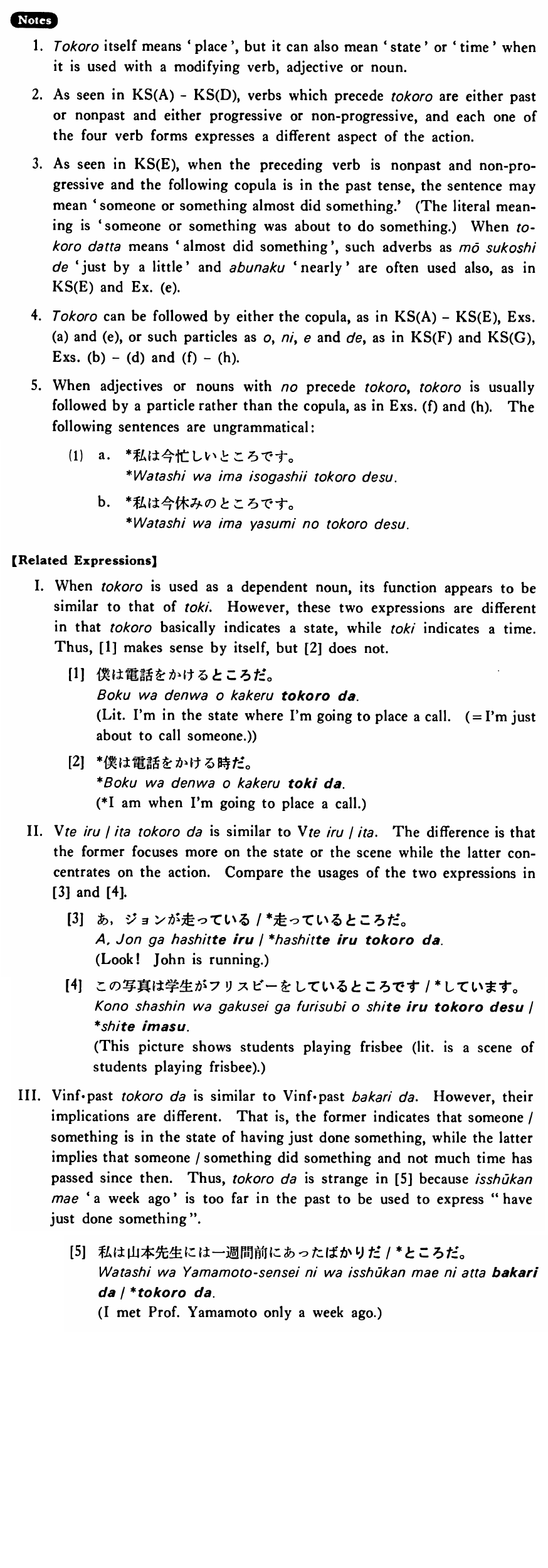
1. ところ itself means 'place', but it can also mean 'state' or 'time' when it is used with a modiiying verb, adjective or noun.
2. As seen in Key Sentence (A) - Key Sentence (D), verbs which precede ところ are either past or nonpast and either progressive or non-progressive, and each one of the four verb forms expresses a different aspect of the action.
3. As seen in Key Sentence (E), when the preceding verb is nonpast and non-progressive and the following copula is in the past tense, the sentence may mean 'someone or something almost did something.' (The literal meaning is 'someone or something was about to do something.') When ところだった means 'almost did something', such adverbs as もう少しで 'just by a little' and 危なく 'nearly' are often used also, as in Key Sentence (E) and Example (e).
4. ところ can be followed by either the copula, as in Key Sentence (A) - Key Sentence (E), Examples (a) and (e), or such particles as を, に, へ and で, as in Key Sentence (F) and Key Sentence (G), Examples (b) - (d) and (f) - (h).
5. When adjectives or nouns with の precede ところ, ところ is usually followed by a particle rather than the copula, as in Examples (f) and (h). The following sentences are ungrammatical:
【Related Expressions】
I. When ところ is used as a dependent noun, its function appears to be similar to that of 時. However, these two expressions are different in that ところ basically indicates a state, while 時 indicates a time. Thus, [1] makes sense by itself, but [2] does not.
[1]
[2]
II. Verbいる/いたところだ is similar to Verbいる/いた. The difference is that the former focuses more on the state or the scene while the latter concentrates on the action. Compare the usages of the two expressions in [3] and [4].
[3]
[4]
III. Verb informal pastところだ is similar to Verb informal pastばかりだ. However, their implications are different. That is, the former indicates that someone/something is in the state of having just done something, while the latter implies that someone/something did something and not much time has passed since then. Thus, ところだ is strange in [5] because 一週間前 'a week ago' is too far in the past to be used to express "have just done something".
[5]